Resisting Decay
Paul Hazelton “takes his time…”
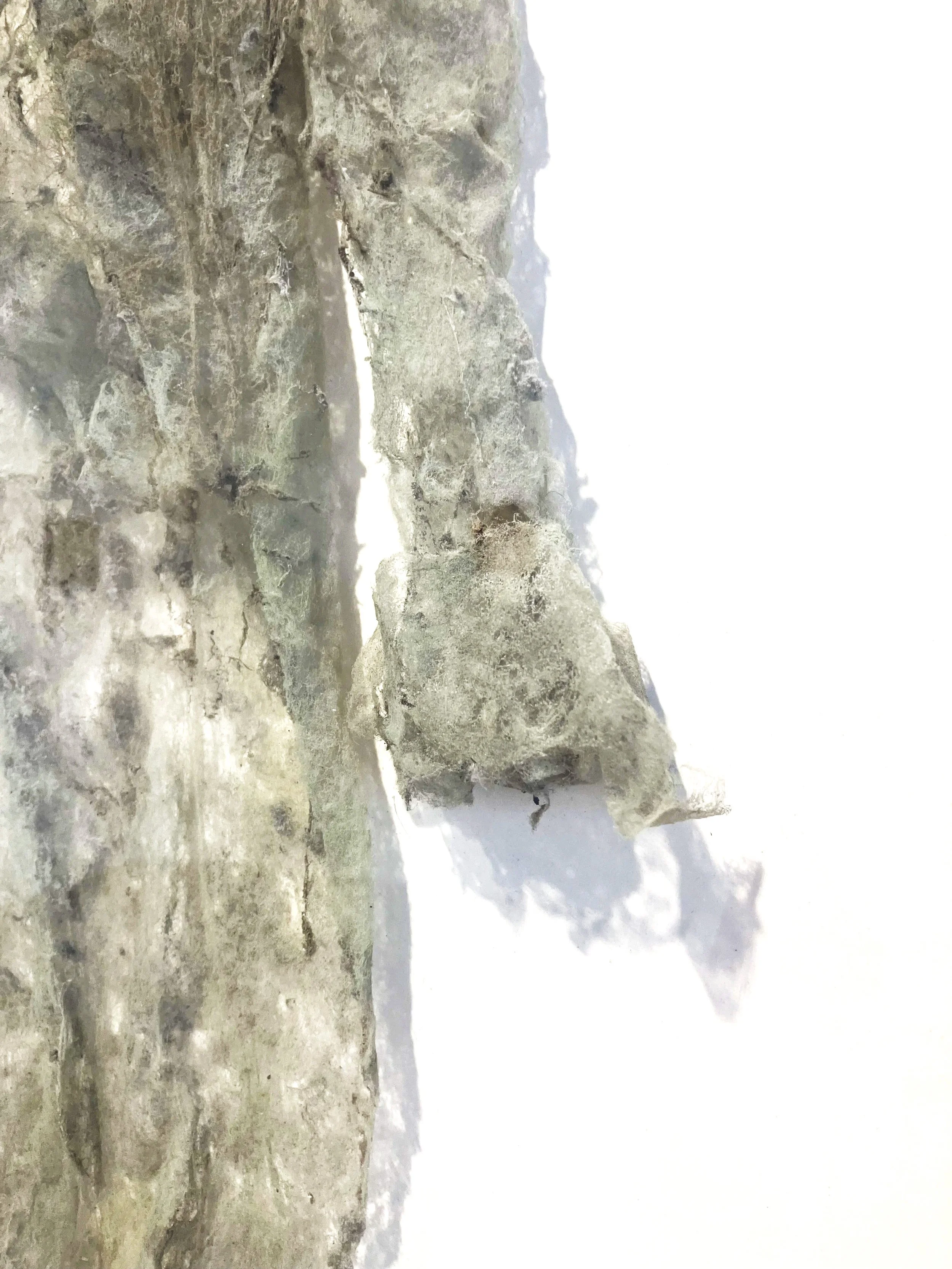
details: Dust Jacket (2011-reworked 2017 household dust, lint, cobwebs, human hair.)
“I don’t really want to just be known as the Dust Man…” says Paul Hazelton to the attendees of his artist talk at The Margate School Gallery on the 12th July 2026.
A quick glance around his beautiful show of works, Age: The Multidimensional Aspect of Time, backs his wishes immediately. Only the glance can’t actually be quick, it has to be measured, because every particle in his works beg to be examined carefully, looked at in depth and assimilated. A tiniest standing man made of hair, dust and lint mustn’t be simply looked over. The craquelures highlighted in Girl With A Pearl Earring ask to be acknowledged and the faces on pottery fragments need more than a second to emerge.
Hazelton is simply encouraging everyone to take time.
Someone in the audience compares his work to that of an alchemist, taking material beyond anything the viewer could have anticipated. Hazelton nods, “perhaps? I don’t know.” His demeanor suggests he’s just always known dust and discarded material hold something bigger, the unseen fragments of our lives. He’s pushed the materiality of these indications further through the simple, human process that is care.
The artist's press release for the show reads like an invitation to accept the slowness he dedicates to his creation:
H takes his time…….
Then gives that time space and shape
In dust hair graphite
Ink paint paper glass mirror
lines wrinkles cracks
cutting scoring
drawing
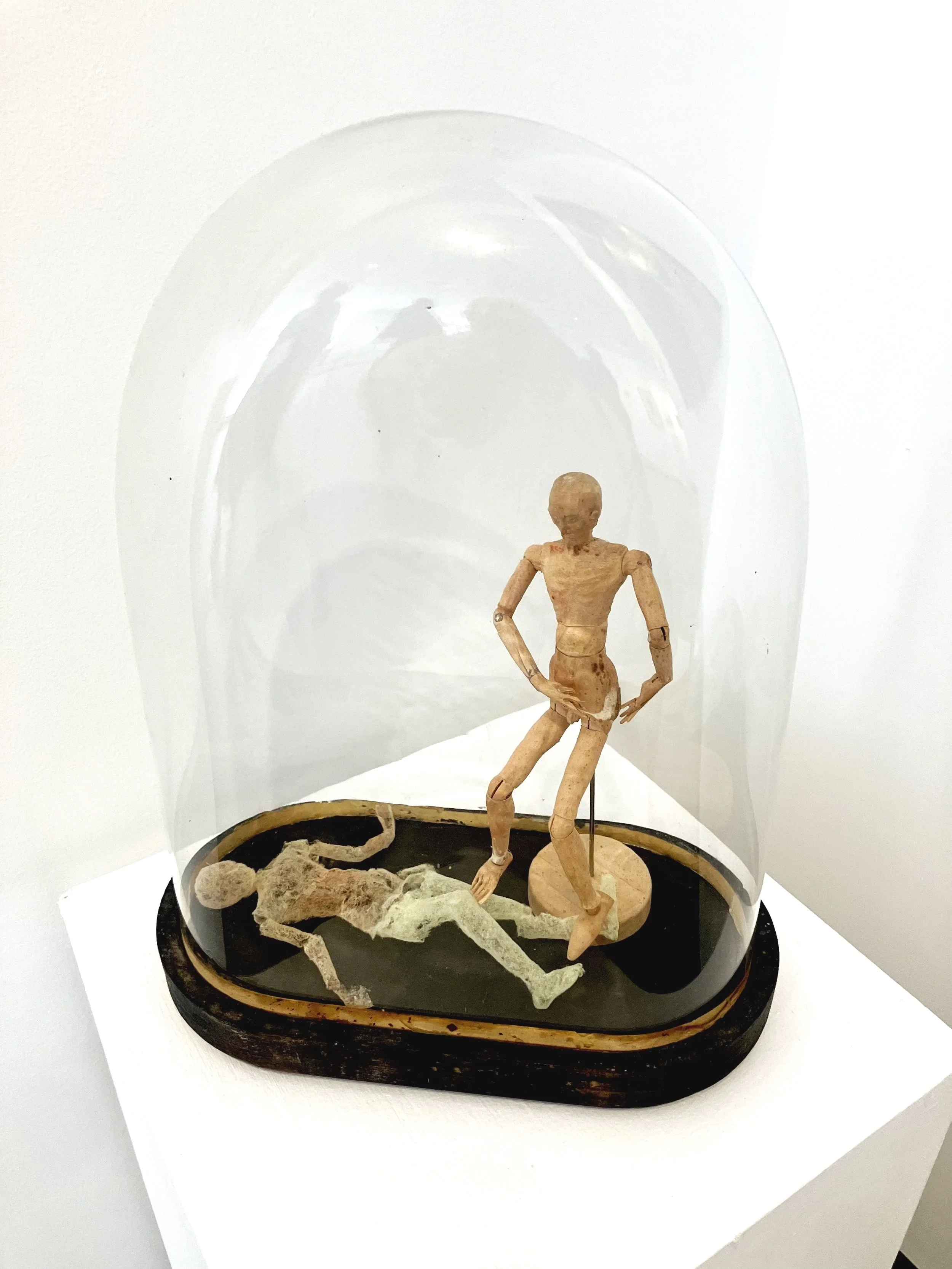
Skin (2018-carved articulated wooden artists manikin, lint, dust, antique French glass dome)
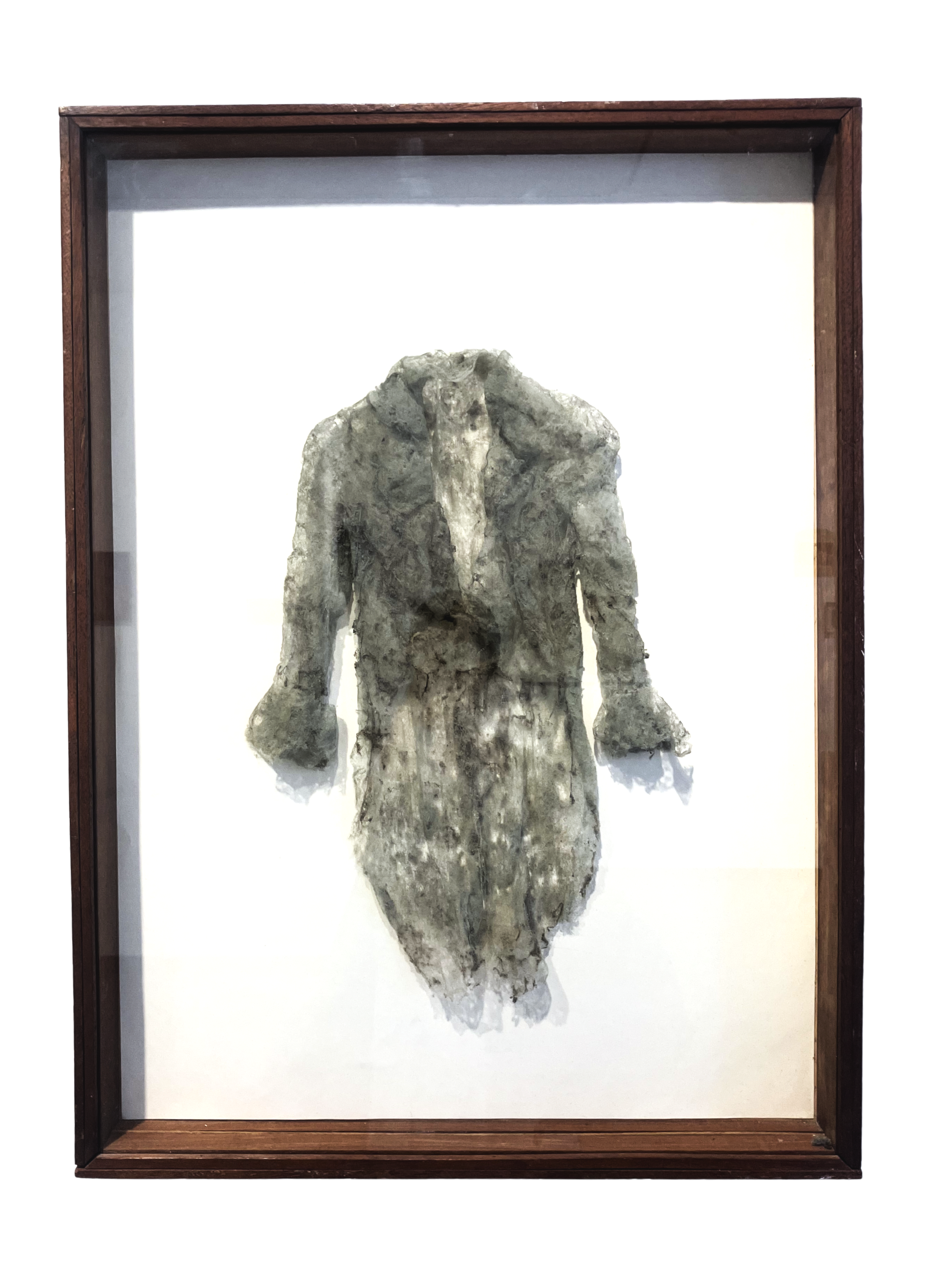
Dust Jacket (2011-reworked 2017) household dust, lint, cobwebs human hair.
Take Dust Jacket (2011 - reworked 2017: household dust, lint & human hair,) for instance. The original role of a dust jacket as we know it, is to act as a comforting and protective cover for books, surrounding with sleek perfection something whose pages are religiously turned, an object whose corners have become bent, a stained cover, a withered spine. A sleeve is a book’s insurance for an aesthetic life beyond the wear and tear of time and the reading process. Dust jackets are the tidy and clean part of a library, adding glitz to the otherwise messy and carnal process that is reading. In short, a dust jacket points to the pristine. Here, Dust Jacket is a small (wearable?) jacket made of flakes that bounce off of human movement - household dust, lint, cobwebs and human hair to be precise. And it’s just as beautiful as the perfect book. Viewers are all hyper-fascinated and disgusted and charmed and repulsed simultaneously and all ask “how??? does it stay together???” Hazelton’s response is always simple, he just gives it all “a bit of time.”
“Using dust as a medium stemmed from growing up in an immaculate house and only being allowed to use pencils.” So a person originally not allowed to care for the frontier between human and non-human response to mess became its greatest caretaker. Hazelton has taken uncontainable material, the flecks that never totally go despite man’s greatest efforts to eradicate or dust off, and he’s rebelliously produced familiar forms from it all. In Skin (2018) a wooden manikin grows a hide of lint and dust and now that the spectral substance is immobile, given limbs and held in one place, the viewer confronts the most un-cherished element of everyday life, growing to love it in its evolution.
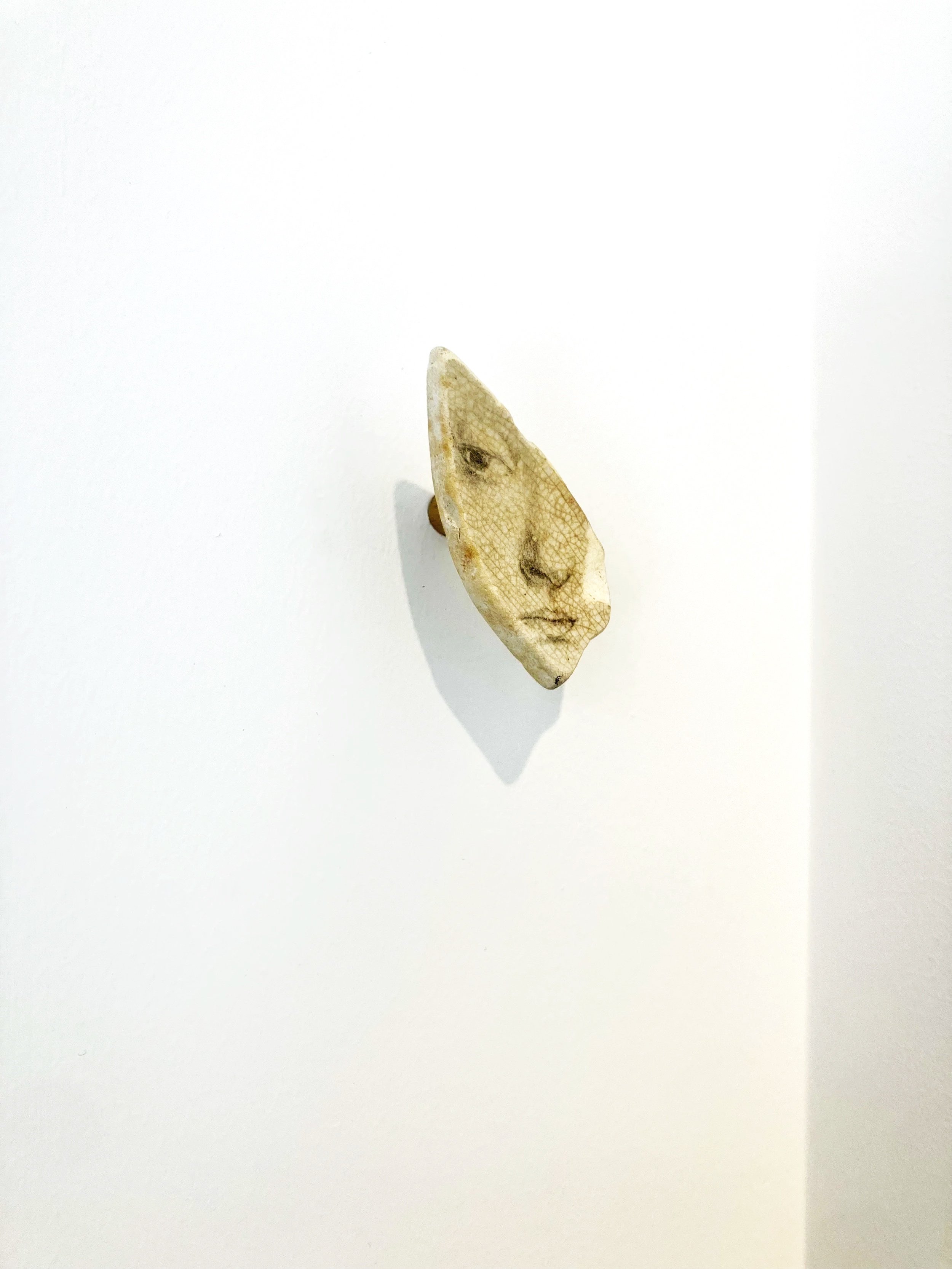
Craquelure Fragment (2026, pencil on found pottery)
With everyone in the room celebrating his obvious patience when dedicating himself to slow, fragile creation, Hazelton simply shrugs, “I don’t actually notice how much time it takes me to create something. I rarely even think about it. I don’t really like to acknowledge passing time as something scary, I’m working with it instead.” Still Life with Apple (2023 household dust & wool fibre) - Apple as in the computer - is the biggest nod to this. This sculpture represents an everyday object, one of our age’s added limbs, and a thick layer of accumulated dust makes the weary viewer look away at the uncanny realisation of discarding the use of such unfortunately indispensable objects.
In the accompanying show text, The Margate School of Art dissects the show’s title and unravels the multidimensional aspects of time:
‘Age’ as a verb, gentle or indefatigable, welcome or worrisome; something which bodies, art, our environment do, but also which is done to us. And ‘age’ as a noun, something static: we have an age, we live in (or through) an age.
When this vivisection of age is applied to each of Paul Hazelton’s sculptures, paintings and works unravel poetic meditations on how time-related objects and their dust have been experienced. Ours is an era that focuses on the big, the larger-than-life successes, and an eruption of superhuman strength. The artist magnifies the small, caring for its understated fragility and draws attention to nimbleness and its surprising survival of time. An almost microscopic human form made out of hair reminds the viewer that there is such a thing as pixie or fairy dust, a type of dreamlike element found within dreams and tales. We wonder if our current age, the one we are and the one we’re living through, pushed us to forget that hopes and dreams could come true… sometimes we just need the time to give it all a new shape.
Moth Dance (2026: print, semi-laminated dust from large moth wings, gold leaf & card) looks something like a near future in which humans embrace the wings of a less-loved night creature. We become one with its frozen movement, and the scene slingshots us back to all the times a moth… or a cluster of cinders from the past…. or sand…. or flakes were ignored in the shadows. Ghost Flicker (2025, household dust, box camera) and (Dark) Lightbulb (date unknown, household dust, wool fibre) halt the renegades found in room corners and suggest their portraiture, their illumination, their importance. Paul Hazelton notices geometry in everyday occurrences, things we forget to look at. His Inkling works reflect the structure and surface of the light play of sunsets and shadows, and instead of keeping it all secret, he tugs at the magic of the equation of time, sometimes leaving it on his canvases as part of the beauty of the pieces. We’re invited to view time as a natural, beautiful thing. Currently, where marks of ageing equal shame, the mathematics behind ticking clocks and its results show the magic of the process. The artist is the fairy dust bringing beauty back to the reality we’re constantly resisting. Pearl, after Girl With The Pearl Earring (2026, paper-cut from vintage print from book, antique gothic style frame) becomes all the more breathtaking as we’re invited to wonder at her age.
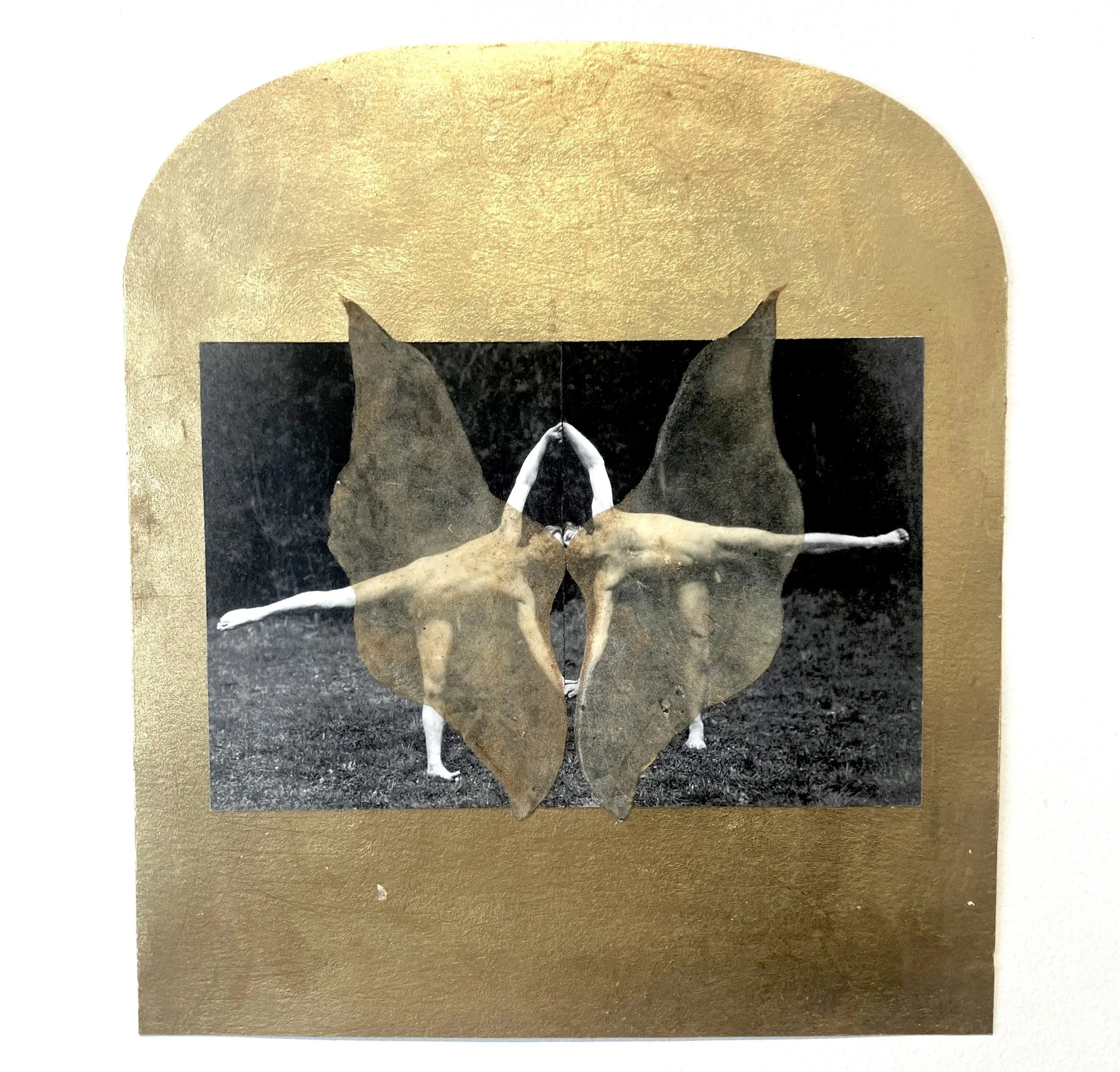
Moth Dance (2016- print, semi-laminated dust from large moth wings, gold leaf, card)
“I really like old things and the stories that come out of them.” As an audience member asks about the philosophical perspectives in his art, Hazelton expresses something more personal, less identifiable. “It’s just that… I need to do it.” His collecting and connecting particles speaks of our past, freezes our present and somehow… predicts our future. Here’s hoping the next ages include Dust Jackets as the most functional fashion choice.
Hope blooms with every sculpture, every mathematical equation shown by the artist, every network of cracks, hair and lint. Each structure becomes a system that adds presence to echoes and materialises the voices of memories, time and the possibilities of the people who participated in the creation of our collective dust bunnies. Paul Hazelton invites us to put our dusty fears to rest in a dreamy Bed of Dust (2026, household dust, painted metal frame.) He smiles as he tells his audience of the people that have sent him dust, commissioning pieces and curious to see where their home’s own filth might take him.
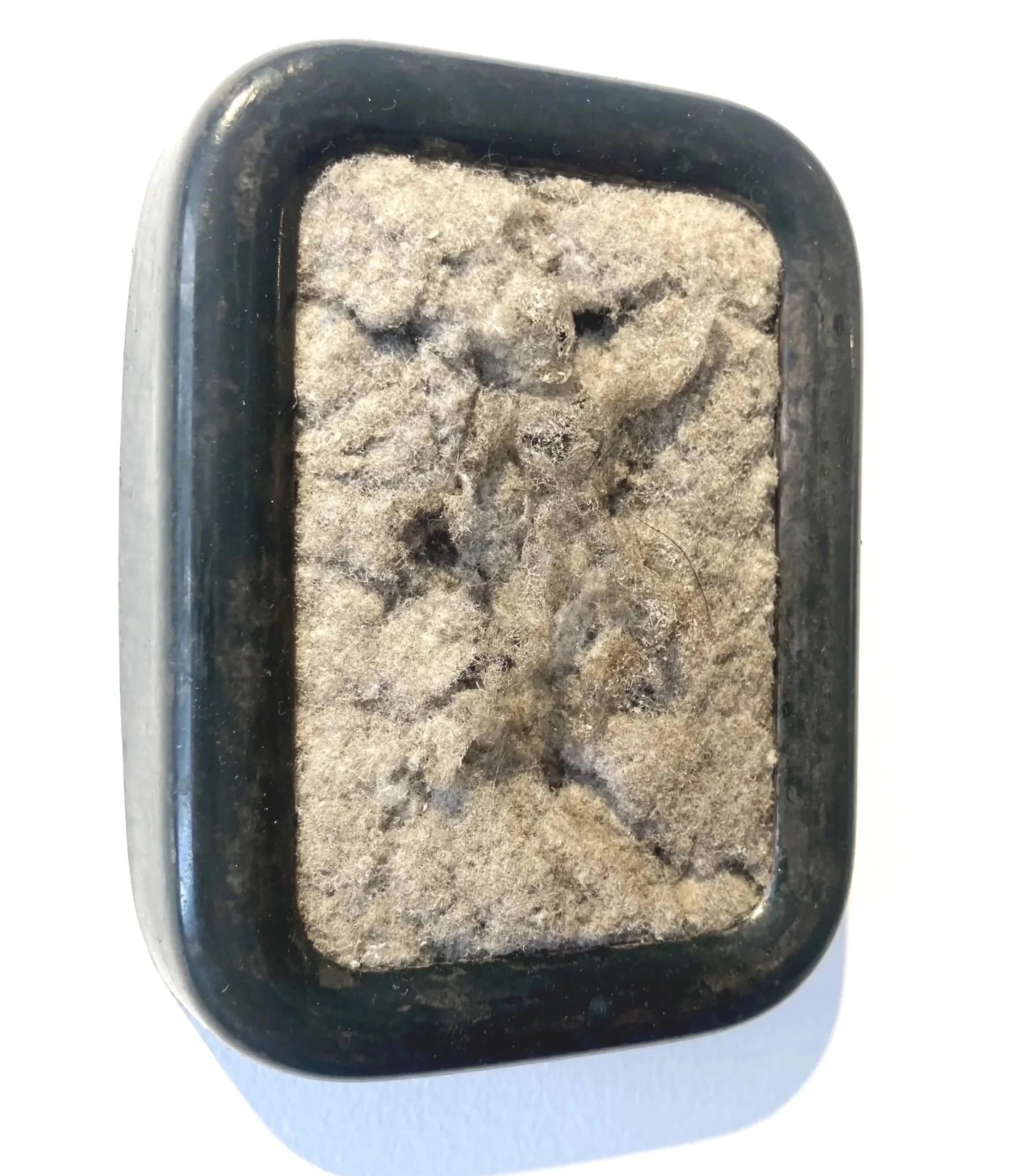
Bed of Dust (2026 - household dust, painted metal frame.)
The artist’s exhibition text chimes in again:
We are the sum of all that precedes us.
Therefore you could say that we are not the age we think we are.
A cluster of words, uttered by the artist on the final day of his beautiful show, echo over and over again:
“I think… I’m in denial of decay.”
Paul Hazelton "Age, The Multidimensional Aspect of Time"2-12 July July 2026, The Margate School of Artwords: Alexia Marmara